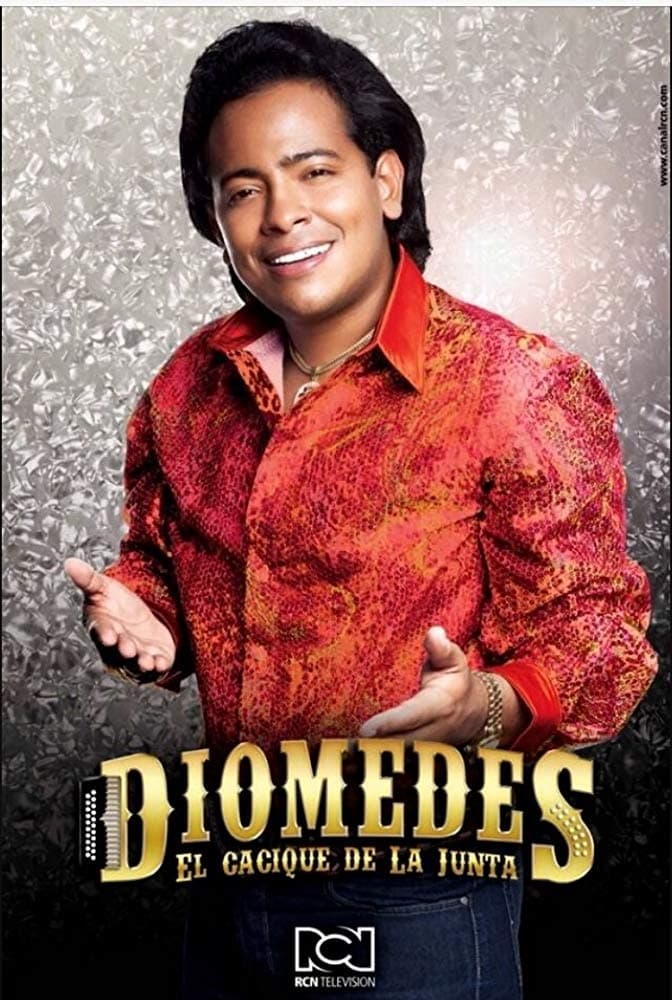
The life and work of vallenato musician Diomedes Díaz, better known as 'The Chief of the Junta'.
Social & External
The people behind it
Orlando Liñán
Diomedes Díaz
Juan Bautista Escalona
Diomedes Díaz (Niño)

Kimberly Reyes
Lucía Arjona
Laura Rodríguez
Lucía Arjona (Joven)
Adriana Ricardo
Elvira Maestre "Mama Vila"

Carlos G. Vergara Montiel
Rafael María Díaz
Emilia Ceballos
Rosa E. Díaz M. "Ocha"

Salomé Camargo
Rosa E. Díaz M. "Ocha" (Niña)

Yorneis García

Rafael Jr. Díaz M.
Jennifer Steffens

Rita
La Madame is a 2013 Spanish-language series produced by RTI Producciones with collaboration of Sierralta Entertainment Group for México-based television network Canal de las Estrellas and United States-based television network UniMás. Alicia Machado stars as the protagonist. As of August 26, 2013, UniMás is broadcasting La Madame weeknights at 10pm/9c, replacing Clorofomo.
The story takes place between the 1920s and 1950s in Greater São Paulo. Going through historical moments, such as the Week of Modern Art, the Revolution of 1924, the economic crisis of 1929 and the Vargas Era, there is the story of Yolanda Penteado, a young woman from a traditional family of São Paulo's high society, who arouses admirations to go through. She had never been easily involved with any other admirer until she meets Martim, a young medical student who catches her eye. However, he was an advocate of the anarchist movement, causing disapproval of Yolanda's mother, Guiomar, but the two will fight to get together, even with the disapproval of the family.
Nakane Kyoko (Ono Machiko) grew up in a wealthy family and was raised by her strict father Shigekazu (Tachi Hiroshi) who did not see learning as a necessity. At 19, Kyoko was introduced to Natsume Soseki (Hasegawa Hiroki) as a prospective marriage partner. The two of them were drawn to each other and got married. Soseki took up a post in Kumamoto as a high school teacher and this was the beginning of their new married life. Although Soseki was an extraordinary intellectual, he did not know the warmth of family because he was given up for adoption as a child. In an attempt to understand her husband, Kyoko tried to read what he read, interacted with his friends and joined difficult conversations. But she was not exactly successful. Then she miscarried their first child and her attempted suicide because of loneliness caused a commotion. How would husband and wife overcome this crisis?
Las Amazonas is a Mexican telenovela produced by Salvador Mejía Alejandre for Televisa and originally broadcast on Las Estrellas from May 16 to September 4, 2016. It is based on the Venezuelan telenovela Amazonas (1985). The story follows ranch owner Victoriano Santos and his three daughters, whose lives are transformed by love, family rivalries, and long-hidden secrets. As old betrayals resurface and unexpected romances develop, they must confront painful truths that will test their relationships, reshape their family, and change their future forever.
Thai-American Annie travels from New York to Ubon Ratchathani for the summer. Despite being disconnected from Isan culture, she finds herself on the path to becoming a morlam singer led by handsome producer Sattaya. She has many competitors, many men fighting for her heart, and a fierce rival in Preem. Will this international girl's dream of becoming a morlam superstar this summer succeed?
Estrella Contreras, a single mother struggling to raise her daughter Azul, finds herself having to return to her hometown after the fateful death of her father Ulises, where she meets Fabián Bravo, a widowed father and fisherman by profession who is fighting to regain custody of his teenage daughter Yazmin. Love blossoms between them, but it will be complicated by the intrigues of Érika Méndez, Fabián's ex-partner, and the ambition of Sergio Falcón, a powerful businessman and Azul's father, who will relentlessly seek to prevent this relationship, even if it means ending the customs and traditions of an entire fishing village, which will lead Fabián and Estrella to face a hurricane of calamities, always putting the well-being of their families first.
A dreamy seamstress and mother of three's life is turned upside down when she's wrongly diagnosed with a terminal disease along with an actually terminally ill wealthy book publisher.
This is the story of four women who live on the paradisiacal Isla de Margarita: Saioa Mujica, Elizabeth Zamora, Rebeca Ponti and Eloína Díaz. The four will be forced to face the issues of fidelity and love with their partners, navigating the difficult waters of self-interest and true feelings.
Mistreated by the Narváez family, the poor and innocent Maricruz is humiliated, abandoned, and imprisoned, losing everything. Upon discovering her true origins, she transforms into a wealthy and powerful woman. Driven by grief and the loss of her father, she vows revenge against everyone who made her suffer.
Based on the original version of same name created by Cris Morena, the series tells the story of a group of orphans living in a manor, known as Raio de Luz, struggling and being guided by a young woman, Carol, that assumes a maternal figure for them. Their experiences such as discovering first love, deceptions, loneliness and friendship, as well as adventures in fantasy, are depicted throughout the series. The narrative is followed by musical themes and videoclips.
After a tragic accident tears them apart, a cheerful student finds healing and unexpected love through the boy who stayed beside him.
Laila is a Syrian victim of a bombing who agrees to marry a powerful sheikh in exchange for money to save her little brother's life. However, plans change due to the tragic death of the child. Laila and her family flee to start a new life in distant lands. Abandoned and enraged, the sheikh sends Jamil, his right-hand man, in search of the bride, but could not imagine he would fail to obey his command and fall madly in love with her. This forbidden love will be tested when the sheikh's daughter decides to take revenge after her father's mysterious death. From Emmy winners Thelma Guedes and Duca Rachid, ‘Orphans of a Nation’ tells a beautiful love story in the current context of refugees from around the world.
Por Siempre mi Amor is an upcoming Mexican telenovela to be produced by Ignacio Sada Madero for Televisa. It is a remake of Mi Segunda Madre, produced by Juan Osorio. in 1990 Canal de las Estrellas will broadcast Mi Segunda Madre after Corazón Indomable concludes in late-September 2013. On June 24, 2013, it was confirmed that Susana González and Guy Ecker will star as the protagonists. Dominika Paleta and Héctor Suárez Gomís will star as the antagonists.
An engineer who works in a large construction company and a poor worker without aspirations both share a love that dared to go beyond all prejudices and differences. Based on the Chilean TV series of the same name.
A man's budding romance with a beautiful woman is sabotaged by his evil twin, but they get another chance at love when they're reunited years later.
Libre para amarte is a Mexican telenovela produced by Emilio Larrosa for Televisa. It is based on Colombian telenovela Los canarios. Gabriel Soto, Eduardo Santamarina star as the protagonists, with the stellar performance of the singer and actress Gloria Trevi for first occasion in a soup opera as Aurora Valencia, while Harry Geithner, Jacqueline Andere and Luz Elena González star as the antagonists.
A historical saga about the second caliph and Commander of the Faithful Omar Bin Al-Khattab and his pivotal role in the Islamic State.
¡Válgame Dios! is a Spanish-language Venezuelan telenovela written by Mónica Montañéz for Venevisión. Sabrina Seara and Eduardo Orozco star as the main protagonists while Ricardo Alamo, Carlota Sosa and Raquel Yanez star as the main antagonists.
This dramatization depicts the life -- and loves -- of Venezuelan Gen. Simón Bolívar who helped liberate several Latin American countries from Spain.
A telenovela that dramatizes the romances and rivalries between two brothers and two sisters in Mexico between the years 1885 and 1900.
María Mercedes, a poor girl who sells lottery tickets, meets a rich man who hates his own family and sees in María Mercedes an opportunity to make their lives miserable.
Emiliano, a wealthy Mexican businessman, is ripped off by his friends and partners. Hidden in Bogotá, he receives help from Rosario, a mariachi singer. She does not know Emiliano’s background and that he is wanted by the police of two countries and by a criminal organization. With a new name and personality, he adapts well to his new life as a mariachi band member and finds in Rosario the love of his life. But he is afraid his secret will tear them apart. He needs to clear his name and resolve his case to avoid that fate. Meanwhile, he often finds his love tested and vulnerable to several rivals, but Rosario always trusts that he has been honest with her.
Against all odds, young Arelys Henao pursues her dream of becoming a singer in this music-filled drama, based on the beginnings of the iconic Colombian star.
Popular telenovela produced in Mexico in 1979, starring Verónica Castro, Rogelio Guerra and Rocío Banquells. Castro also sang the theme Aprendí a Llorar, a song written by Lolita de la Colina. The telenovela was produced by Chilean Valentín Pimstein and Carlos Romero, it was directed by Rafael Banquells. The story was written by Inés Rodena and adapted by Valeria Philips.
Sofía Peralta-Avitia Villaseñor, a successful businesswoman and great mother, who feels lonely in her marriage to Gonzalo Balmori-Ricci Nava. At the same time, her daughter, Bárbara Balmori-Ricci Peralta-Avitia, and her young bodyguard, Salvador "Chava" Reyes Encino, will transform their rebelliousness into passion. But none of them know that the evil, ambitious people around them will try to meddle in their paths on their road to love.
Story of love between Marimar and Sergio. Sergio is from a wealthy family, and Marimar lives with her poor grandparents in a hut in front of the ocean.
Piel de otoño is a Mexican telenovela that was produced by Televisa and broadcast on El Canal de las Estrellas in Mexico from 9 May 2005 through 23 September 2005 in Mexico, and from October 10, 2005, through February 17, 2005, in the United States. Starring Laura Flores and René Strickler as the series' protagonists, the show tells the story of Lucía Villarreal de Mendoza, a woman who seeks refuge from her husband and children's abuses in the friendship of a stranger on the Internet, who signs his messages only as "wind". Piel de otoño is a remake of the 1986 Televisa telenovela Cicatrices del alma. The program aired weekdays at 5 pm for twenty weeks.
When Refugio and her three sons—Patricio, Edmundo, and Ignacio—are forced out of their home, a twist of fate brings them to Mexico City, where they begin a new life. Eighteen years later, they are settled in a small apartment in a working-class neighborhood. Refugio holds a modest job; although she suffers from serious vision problems, she neglects her own health to attend to her sons' needs. Patricio is studying law and dreams of a comfortable, prosperous future; his mother admires him for his charitable nature. Meanwhile, Edmundo begins courting Lucero—unintentionally hurting Ignacio, who secretly loved her—while Refugio tries in vain to make Patricio understand that he will never be happy with Olga.
Dulce Desafío is a Mexican telenovela starring Adela Noriega and Eduardo Yáñez.
Teresa Chavez is a young woman with an obsession for money and ambition. Despite her beauty and the fact that she was raised in the bosom of a loving family, she is resentful; her one desire is to leave her humble but poor neighbourhood.
Qué bonito amor is a 2012 Mexican telenovela produced by Salvador Mejía Alexandre for Televisa. It is based on La Hija del Mariachi, produced by Colombian's RCN Television and written by Mónica Agudelo in 2006-2007. Jorge Salinas and Danna García star as the protagonists, while Malillany Marin, Roberto Palazuelos, Marcelo Buquet, Salvador Pineda and Pablo Montero star as the antagonists.
Fernanda Linares (Livia Brito) is a woman thirsty for revenge after the murder of her husband on their wedding night, where in addition, Fernanda was a victim of rape after the event occurred. However, Fernanda's life will change when she meets Rafael Toscano (José Ron), a handsome young man who recently just received his university degree with whom she will empathize and return to Fernanda the opportunity to love again.
When Marichuy was born, her mother—believing she was on the verge of death—handed her over to a priest, who took her to an orphanage. At the age of fourteen, Marichuy ran away from the institution and began wandering from place to place, scraping together a living however she could. Years later, she was attacked by a drunkard; the incident left her harboring resentment toward men and plagued by harrowing nightmares.
Rebeca murders her sister Adriana to end up with the man she loved, and becomes the step mother of her niece Lucía. Nora, Lucía's half sister and daughter of Rebeca, resents Lucía for the same reasons Rebeca hated Adriana, as history repeats itself.
The adventures of Vicenta Acero, the feared coyote who now leads the dynasty of illicit dealings once under the control of her father.
Yo no creo en los hombres (I don't trust men anymore) is a Mexican telenovela produced by Giselle González for Televisa. It is based on Yo no creo en los hombres (1991), produced in México.